Siemens' "True Cost of Downtime 2024" analysis shows that downtime costs at large plants have surged in just a couple of years, driven by more complex, tightly-coupled supply chains and higher input costs. Broader industry analysts estimate that for the world's 500 largest companies, unplanned downtime now eats about 11% of total revenues, rising from roughly USD 864 billion in 2019–2020 to around USD 1.4 trillion by 2024, a staggering 62% jump.
That's the large-enterprise end of town. For SME manufacturers, the absolute numbers are smaller, but the impact is often more brutal: thinner margins, fewer buffers, and less pricing power mean a single significant unplanned stoppage can put a whole year's performance at risk.
The hidden iceberg of unplanned downtime costs
Here's the trap most of us fall into: we talk about downtime as "cost per hour" and stop there. It makes the problem feel tidy, and it massively underestimates the damage.
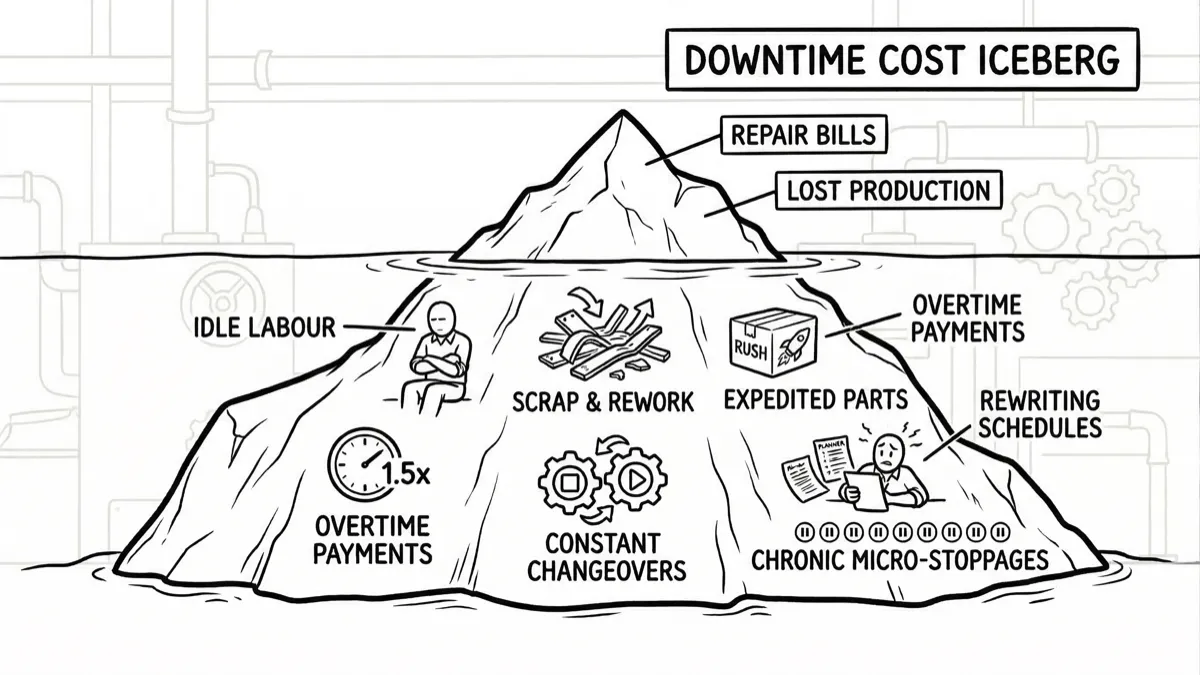
In reality, the impact of unplanned downtime is more like an iceberg. Above the waterline you have the obvious stuff: repair bills, spare parts, lost production for the shift. Below the waterline is where it gets interesting, and uncomfortable. There you find idle labour, contractor call-ins, expedited parts bought at hefty premiums, overtime paid at 1.5–2x rates, and scrap generated when you shut down and restart unstable processes.
Inside the four walls of the factory, those hidden costs also show up as constant changeovers, extra cleaning and setup time, rework and waste product, planners rewriting schedules at short notice just to keep lines busy. Over time, chronic micro-stoppages (those small, frequent interruptions we learn to live with) can be more damaging than the occasional catastrophic breakdown because they normalise process instability and quietly mask true performance losses.
Across studies and real-world experience, the pattern is consistent: once you add up all those items below the waterline, the hidden costs often outweigh the visible ones by a factor of two or three. Downtime stops being a "maintenance issue" and becomes a strategic threat to how efficiently your operations run day in, day out.
From a line stoppage to a shaky supply chain
That's the story inside your plant. The more connected your supply chain, the further the shockwaves travel outside it.
A couple of hours lost on one critical process might not look disastrous on the daily report, but it can show up days or weeks later as longer customer lead times, backorders, and misaligned production plans across your network, especially if you're running lean or just-in-time. What starts as a local issue in one facility quietly becomes a planning problem for your customers and their customers.
As those ripples spread, trust erodes. Frequent stoppages push customers and suppliers to quietly seek more reliable partners, weakening the overall network. Pair that with Siemens' finding that penalties for missed contractual deliveries and downstream chargebacks from OEMs and big retailers are now a major component of downtime cost, and you start to see the full picture. Downtime isn't just a bad week in the plant: it's a source of supply-chain instability that shows up in customer scorecards, allocation decisions, and eventually market share.
In other words, every unplanned stoppage is a tiny stress test of your supply relationships. Too many failures, and your place in the network is no longer guaranteed.
SMEs vs large enterprises: different exposure, same pain
Most of the research on downtime focuses on global giants, but the story plays out differently when you zoom in on SMEs.
Siemens notes that the burden of downtime is often heaviest on lower-tier and heavy-industry suppliers, who face the stiffest penalties for non-delivery even though they have the least pricing power and resilience. That's a fair description of many SME manufacturers feeding bigger brands: they sit in the squeeze zone, forced to absorb disruptions with limited ability to pass costs on.
On top of that, many SMEs are still running with siloed decision-making and "heroic effort" culture when things go wrong. When something breaks, production, maintenance, sales, procurement and finance are often not reading from the same playbook, so recovery is slower and more expensive than it needs to be. Everyone is busy; not everyone is aligned.
At the same time, the upside for SMEs is huge. The same resilience themes that large enterprises talk about (mapping critical risks, tightening coordination, and investing in basic predictive practices) are often less mature in smaller plants, which means the gains from improving them can be disproportionate. For many smaller manufacturers, downtime isn't just an efficiency problem; it's a survival problem.
And then there's frequency. ABB's global survey of 3,215 industrial decision-makers found that around two-thirds of industrial businesses experience unplanned outages at least once a month. Eighty-three percent estimate unplanned downtime costs at least USD 10,000 per hour, and many report figures far higher. That combination (high cost and routine frequency) is exactly what makes this a "silent crisis" for SMEs: the hit is big enough to hurt, but familiar enough to be accepted or normalised as part of doing business.
So what do we do about it?
If downtime is this expensive and this frequent, why haven't we fixed it? ABB calls this out directly: despite the cost, a large share of plants haven't modernised their motor-driven systems in the last two years, effectively leaving avoidable downtime on the table.
The answer isn't a single silver bullet. Across the research and in day-to-day practice, a few themes show up consistently:
Get serious about operational discipline. Technology alone won't save you. Standard work, robust root-cause analysis, and realistic scheduling are what keep the gains from slipping away once the crisis passes. Chronic micro-stoppages live in the gaps where process discipline has eroded. Cleaning up those basics is often the fastest, cheapest way to claw back lost uptime.
Shift from "run to fail" to "know before it fails." Studies like ABB's Value of Reliability work show that condition-based and predictive maintenance strategies deliver better uptime than reactive ones, and yet a sizeable minority of plants still rely on run-to-fail approaches. For SMEs, the goal isn't a NASA-grade predictive stack; it's a practical step up from firefighting to foresight: using the data you already have to spot patterns, set sensible inspection intervals, and intervene before a failure takes a line down.
Treat downtime as a supply-chain risk, not just a maintenance KPI. In Siemens' work and in most resilience frameworks, downtime is directly linked to performance across lead times, service levels, and supply-chain penalties. That means operations, supply chain, and commercial teams need to plan together: which lines are truly critical, which customers are most sensitive, and what's the playbook when something goes down? When you plan downtime responses with customers and suppliers in mind, you design different priorities and better communication.
Strengthen cross-functional decision-making in SMEs. SME teams often respond to downtime in silos: maintenance fights the fire, production worries about today's schedule, sales manage angry calls, and finance counts the cost after the fact. The fix is deceptively simple: get the right people in the (physical or virtual) room quickly when something breaks, work from shared data, and agree who owns what in the first 24–48 hours of a disruption. Having that playbook decided before the event can shave days off recovery.
Where AI-powered knowledge capture fits
One pattern across all these studies, and across most plants, is how often the same mistakes repeat. The root causes were found, the workaround was invented, the lesson was learned… and then it walked out the door when a key person wasn't on shift or went on leave or left the business.
That's where enterprise knowledge capture starts to matter. If your best troubleshooting steps, changeover tips, and recovery playbooks live in people's heads or scattered emails and WhatsApp messages, you are structurally vulnerable to downtime. An AI-enabled knowledge platform can help SMEs:
- Capture operational know-how from shift leaders, technicians and planners in the flow of work.
- Turn those insights into searchable, context-aware guidance when the next incident hits.
- Shorten the time from "it's broken" to "we know what to do", which is ultimately where a big chunk of the hidden cost lives.
Downtime will never disappear, but the gap between plants that learn from it and plants that relive it every quarter is widening. For SME manufacturers, closing that gap is one of the most powerful moves you can make.