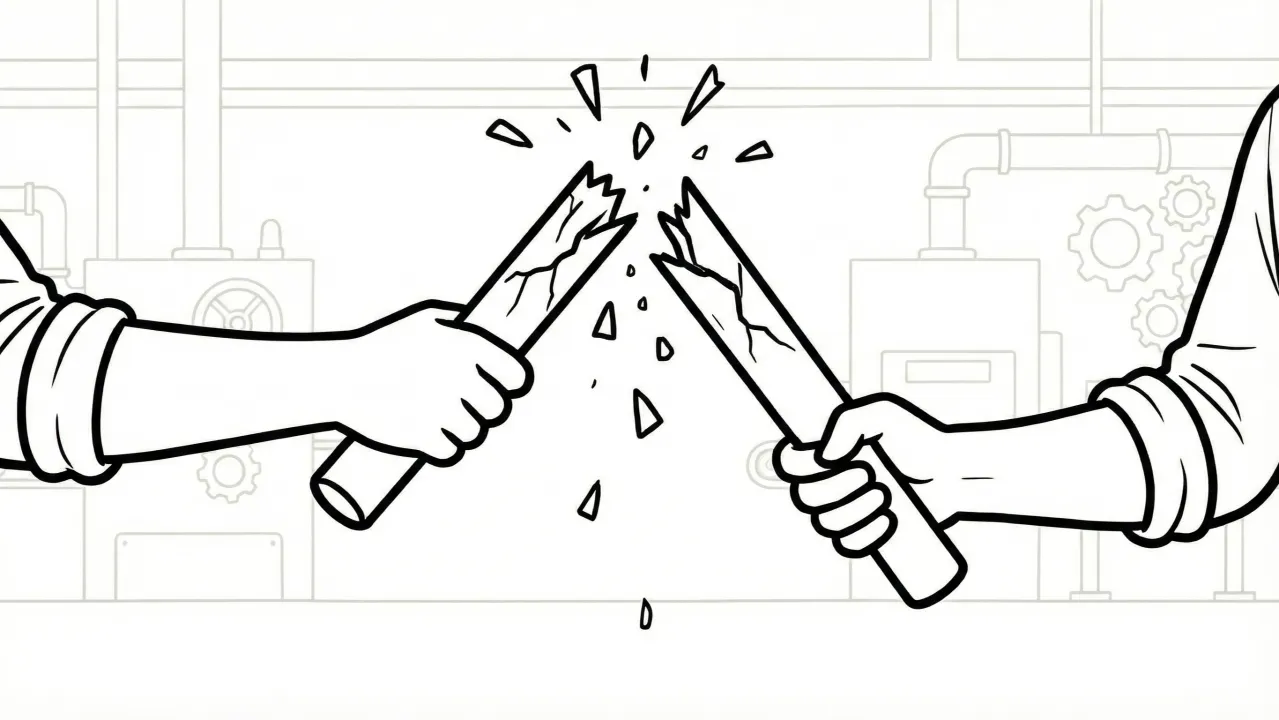
You're coming in for your shift. You receive an email on your phone from your existing MES software with a brief three-sentence overview of the last shift. "Line 4 packing machine heat sealing had issue, packaging not sealed properly. Fixed by tightening crimper brace".
Cool, Sean's handled it. He's posted an image in the WhatsApp group chat of what he did. He's even left a lovely little voice note explaining the fix in detail.
Lots of data in lots of places. What could go wrong…
Well, lots of things can go wrong.
Seven weeks later, Line 4's packaging machine has a similar issue. It's mayhem now. The first thing you do is pull out your phone and look through your emails. "Line 4, line 4…" Since the last incident, Line 4 has been mentioned at least 30 other times. Let's not forget searching for an email is one of the most difficult things to do. If you find it, you'll only be met with three sentences.
And the headache begins. It's now a frantic search to find that one voice note and image from Sean in the WhatsApp group chat. You'll click on the media in the group chat, and scroll endlessly through weeks of cat pictures, morning coffee photos, and random memes trying to find that one fix.
Maybe you'll give up and call Sean. And at that time, Sean's not contactable. Great. You're back at square one.
The Root Issue With Shift Handovers
We treat shift handovers like one way communication forms. An announcement. An email. A report.
There's no room for back and forth, nor is there editing of prior reports. It's simply emails after emails. The workaround to this is WhatsApp. But this is but a mere bandaid on the cause.
The heart of the issue lies in systems which aren't tailored to the complexity of issues and reporting. Communication between shifts can't easily be summarised at the end of a shift in a short email. Things happen spontaneously. Writing out words isn't enough. People forget.
Because we rely so much on systems focused around consistent reports which are restrictive in the type of data that goes in, we barely get useful information out of it.
It's one of the main reasons we started RossOps in the first place. We've experienced that frustration first hand. When you can't find the help you need in shift handovers, you rely on WhatsApp only to realise you inevitably need the person themselves.
For us, that person was someone named Ross.
A Ross That Never Leaves
Ross was the person who knew everything. When he was off shift, it felt like everything went back to square one. No one else understood the packing machine better than he did.
That's why RossOps was born. To make each shift handover easy, and contain all the information you need all in one place. Regardless of whether you upload a manual, a photo, a text entry, or a voice note, having everything in one place that could easily be found.
Shift handovers don't need to be restricted to the end of a shift. Make a little voice note on an issue as it happens. Take a photo of the fix. And as you walk out of the factory, leave a little voice note on what's been achieved. Ross will take care of the rest.
We've made RossOps with a goal of never running into these issues again. Operational know-how should be easily accessible, all in one place.